AI call center solutions combine automation, real-time assistance, and analytics to help contact centers handle more conversations with higher consistency and better customer experiences. Instead of relying solely on manual processes, AI supports agents, streamlines routine tasks, and extracts actionable insights from every interaction.
For many organizations, the biggest payoff is practical: shorter wait times, improved first-contact resolution, more productive agents, and measurable cost efficiencies. An omnichannel support contact center tools approach ensures these benefits are delivered seamlessly across all customer communication channels.
When planning deployment, it’s important to consider AI call center solutions pricing. Costs can vary depending on AI capabilities, the number of agents, interaction volumes, and integrations with existing systems. Understanding pricing upfront allows organizations to align investments with operational goals, scale efficiently, and ensure that AI solutions deliver measurable improvements in both customer experience and agent performance.
What “AI call center solutions” typically include
In a call center, “AI” is rarely a single tool. It is usually a set of capabilities that can work independently or as an integrated platform. The most effective deployments align these capabilities to your customer journey and service goals, highlighting the impact of ai call center software.
Core capabilities you will see in modern AI call centers
- Conversational AI for voice and chat: automated assistants that can answer questions, complete tasks, and route customers.
- Intelligent routing: predicts the best agent or queue for each customer based on intent, history, and priority.
- Agent assist: real-time suggestions, knowledge retrieval, next-best actions, and response coaching while the agent is on the call.
- Speech-to-text and call transcription: converts conversations into searchable text for quality, compliance, and insights.
- Post-call automation: summaries, disposition codes, follow-up tasks, and CRM updates completed automatically.
- Quality management and interaction analytics: identifies trends, sentiment, recurring issues, and coaching opportunities.
- Workforce optimization support: forecasting and scheduling enhancements based on demand signals.
These capabilities illustrate how an ai based contact center operates efficiently and why implementing a comprehensive ai contact center service is essential for modern, intelligent, and scalable customer support.
Top AI Call Center Solutions
AI call center solutions use artificial intelligence, machine learning, natural language processing, and automation to help businesses improve customer interactions, enhance agent productivity, and optimize call center operations. These solutions are designed to reduce handling times, deliver consistent omnichannel support, and provide actionable insights. Here are some of the top AI call center solutions:
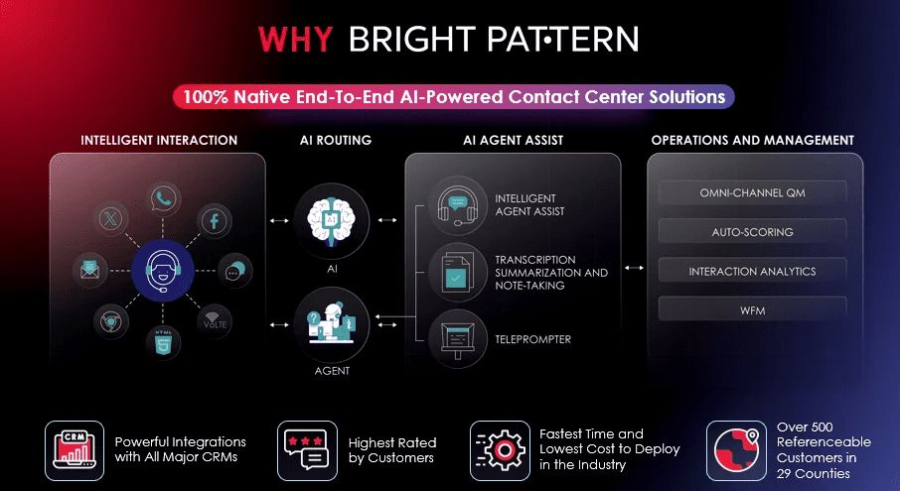
1. Bright Pattern — Enterprise AI Call Center Solution

Bright Pattern offers a comprehensive AI call center solution built for enterprises needing scalability, automation, and omnichannel engagement. Its platform enables businesses to reduce operational costs, improve first-contact resolution, and enhance customer satisfaction.
Key Features and Benefits:
- Automated virtual agents handle high volumes of routine inquiries such as billing questions, order tracking, FAQs, appointment scheduling, and returns, freeing live agents for complex cases.
- Intelligent routing ensures customers are connected to the most suitable agent based on skills, sentiment, interaction history, and predicted needs.
- Omnichannel engagement allows seamless communication across voice, chat, SMS, email, messaging apps, and video, keeping conversation context intact.
- Real-time agent assistance provides suggested responses, knowledge base articles, next-best actions, and sentiment analysis during live interactions.
- Workflow automation reduces repetitive tasks like ticket creation, follow-ups, notifications, and surveys.
- Predictive analytics monitors interaction trends, customer sentiment, and agent performance to optimize staffing and workflows.
- Integration services connect with CRM systems, workforce management, and marketing platforms, leveraging existing enterprise technology.
- Proactive engagement automates notifications for delays, updates, or promotions, reducing inbound contacts and improving customer experience.
- Enterprise scalability and security provide compliance-ready features, disaster recovery, and data protection.
- Commercial ROI: Enterprises using Bright Pattern report lower call handling times, higher customer satisfaction, and cost savings, making it a high-value solution for large-scale operations.
Bright Pattern is trusted by enterprises in healthcare, finance, retail, and telecommunications for intelligent, automated, and commercially optimized AI call center solutions.
2. 8x8 AI Call Center Solutions
8x8 provides AI-powered call center solutions with virtual agents, predictive routing, and speech analytics. Businesses can automate routine interactions, optimize agent workloads, and improve customer engagement.
3. NICE CXone AI Call Center Solutions
NICE CXone combines AI automation, workforce optimization, and real-time coaching to improve agent performance, reduce handling times, and deliver consistent service.
4. Twilio AI Call Center Solutions
Twilio offers AI-powered virtual agents, smart IVR, and real-time agent assistance, helping enterprises automate calls and optimize contact center operations.
5. Amazon Connect AI Call Center Solutions
Amazon Connect uses AI technologies like Amazon Lex and Contact Lens for virtual agent automation, sentiment analysis, and call transcription, enabling enterprise-scale support.
6. Talkdesk AI Call Center Solutions
Talkdesk provides AI virtual agents, workflow automation, and real-time agent guidance to improve resolution speed and optimize staffing.
7. Zendesk AI Call Center Solutions
Zendesk automates ticket routing, conversational bots, and knowledge base suggestions to reduce agent workload and accelerate call resolution.
8. Microsoft Dynamics 365 AI Call Center Solutions
Microsoft Dynamics 365 offers AI-assisted call routing, predictive recommendations, and virtual agent support to enhance operational efficiency and customer service.
9. Salesforce Service Cloud + Einstein AI Call Center Solutions
Salesforce Einstein integrates AI into Service Cloud for intelligent routing, predictive recommendations, workflow automation, and agent guidance, improving enterprise efficiency and customer satisfaction.
10. Five9 AI Call Center Solutions
Five9 provides AI virtual agents, smart IVR, and real-time agent assistance to automate repetitive interactions and optimize call center productivity.
Why AI is a strong fit for call centers
Call centers are high-volume, high-variability environments. Many interactions follow repeatable patterns (password resets, order status, appointment scheduling), and even complex calls benefit from quick access to knowledge and consistent processes. AI can help with both.
When designed well, AI does not just reduce costs. It can also raise service quality by making “best practice” easier to deliver on every call, including during peak demand.
Benefits that matter to customers
- Faster answers through self-service and smarter routing.
- Less repetition when AI uses context (account details, previous interactions, stated intent) to guide the conversation.
- More consistent service because agents receive the right guidance at the right time.
- 24/7 coverage for common requests with conversational AI, even when live agents are offline.
Benefits that matter to operations and leadership
- Lower average handle time through real-time guidance, better knowledge access, and automated after-call work.
- Higher first-contact resolution when agents are supported with next-best actions and better routing.
- Improved quality assurance with scalable evaluation across more interactions, not just a small sample.
- Better coaching using data-driven insights from transcripts, sentiment signals, and call drivers.
- Stronger reporting with consistent tagging, summaries, and root-cause analysis of repeat contacts.
Key AI use cases in call center workflows
AI creates the biggest impact when it is applied across the full lifecycle of an interaction: before the call, during the call, and after the call.
1) AI-powered self-service (voice bots and chatbots)
Self-service is often the entry point for AI in contact centers because it can quickly absorb high-frequency, low-complexity requests. A well-designed assistant can verify identity, look up information, and complete tasks without agent involvement.
High-value self-service outcomes include:
- Reduced queue volume for routine inquiries.
- Improved speed to resolution for common tasks.
- Better containment with smart escalation (handoff to an agent with conversation context intact).
2) Intelligent routing and prioritization
AI routing can use signals like customer intent, product line, language, predicted complexity, customer value, and urgency to match callers to the best available resource. This can increase resolution rates and reduce transfers.
Routing can also be used to:
- Send specific intents to specialized teams.
- Balance workloads across channels.
- Prioritize time-sensitive or high-impact cases.
3) Real-time agent assist
Agent assist tools support representatives during live interactions by surfacing relevant knowledge articles, policies, troubleshooting steps, or compliance reminders based on the current conversation.
Common agent assist features include:
- Real-time transcription so key details are captured automatically.
- Contextual knowledge retrieval that reduces manual searching.
- Suggested responses for chat and structured guidance for voice calls.
- Next-best action prompts to keep calls moving toward resolution.
When agents spend less time navigating systems and more time listening, customer experience tends to improve.
4) Automated summaries and after-call work
After-call work can quietly consume a significant portion of agent time. AI can generate structured call summaries, categorize the reason for contact, and suggest disposition codes. It can also draft follow-up messages or create service tickets with the right fields populated.
Positive outcomes include:
- More time on calls that need a human and less time on paperwork.
- More consistent documentation for future contacts and escalations.
- Cleaner data for reporting and operational improvement.
5) Conversation analytics for insights and continuous improvement
Every customer conversation contains signals about product friction, policy confusion, service gaps, and training needs. AI-driven analytics can summarize themes, measure sentiment at scale, and identify the main drivers behind repeat contacts.
Organizations often use these insights to:
- Reduce avoidable contacts by fixing upstream issues.
- Improve scripts, workflows, and knowledge bases.
- Strengthen coaching with examples drawn from real interactions.
Common solution types: how to choose the right approach
AI call center solutions come in different packaging: point tools, add-ons to existing CCaaS platforms, and end-to-end suites. The “right” choice depends on your current stack, your adoption timeline, and your operational goals.
| Solution type | Best for | Typical strengths |
|---|---|---|
| AI add-on to your current contact center platform | Teams that want faster deployment with minimal disruption | Quicker integration, familiar admin experience, consistent reporting |
| Specialized point solution (agent assist, QA analytics, voice bot) | Organizations targeting a specific pain point first | Deep capability in one area, flexible rollout, clear ROI measurement |
| End-to-end AI suite across channels | Enterprises building a unified customer experience strategy | Shared data layer, consistent orchestration, strong scalability |
How AI improves key call center metrics
AI is most persuasive when it ties directly to the outcomes leaders care about. While results vary by industry, process maturity, and use case, AI typically targets a handful of core performance indicators.
Average handle time (AHT)
- Real-time knowledge surfacing reduces time spent searching.
- Automation reduces repetitive verification and form filling.
- Post-call summaries shorten wrap-up.
First-contact resolution (FCR)
- Smarter routing connects customers to the right expertise sooner.
- Agent assist keeps steps consistent and reduces missed actions.
- Analytics reveal repeat drivers so teams can eliminate them.
Customer satisfaction (CSAT) and customer effort
- Faster resolution and fewer transfers reduce customer effort.
- More consistent experiences reduce frustration and re-contact.
- 24/7 automated support improves convenience for routine tasks.
Quality and compliance
- Transcription enables broader review and targeted coaching.
- Real-time prompts help agents follow required disclosures and steps.
- Structured summaries improve documentation quality.
What successful AI call center adoption looks like
AI adoption works best when it is treated as an operational program rather than a one-time tool purchase. The most successful teams start with measurable goals, deploy in phases, and continuously tune based on real interactions.
Step 1: Pick a high-impact starting point
Good first projects are typically narrow enough to implement quickly but large enough to show meaningful impact. Examples include:
- Automating call summaries and after-call work.
- Launching agent assist for a single queue (billing, retention, technical support).
- Deploying self-service for one or two common intents (order status, appointment scheduling).
Step 2: Prepare the knowledge and workflow foundations
AI performs best with clear, current inputs. Before rollout, many teams invest in:
- Knowledge base cleanup (duplicates removed, articles standardized, owners assigned).
- Defined workflows for common issues so AI can guide consistent steps.
- Taxonomy for intents and outcomes so analytics and routing remain meaningful.
Step 3: Integrate with core systems
To deliver smooth experiences, AI solutions commonly connect to systems such as CRM, ticketing, order management, and identity verification. This enables automation that is not just conversational, but transactional.
Step 4: Pilot, measure, and iterate
Pilots are where you validate real-world value. Effective pilots usually include:
- Clear success metrics (for example, AHT reduction, wrap-time reduction, containment rate, transfer reduction).
- A defined set of intents or queues.
- Agent feedback loops to improve guidance quality.
- Ongoing tuning of prompts, knowledge, and routing logic.
Step 5: Scale with governance
As you scale, governance helps maintain quality and consistency. This can include:
- Ownership for knowledge content and updates.
- Review cycles for automation workflows.
- Quality monitoring policies and consistent evaluation criteria.
- Change management and training plans for new AI capabilities.
Where AI tends to deliver the strongest ROI
ROI is typically strongest when AI reduces repetitive work and improves consistency in high-volume environments. A few areas often stand out:
- High-volume repetitive inquiries: ideal for self-service and automation.
- Complex support queues: strong fit for agent assist and knowledge surfacing.
- After-call documentation-heavy teams: strong fit for automated summaries and CRM updates.
- Quality programs limited by sampling: analytics can scale evaluation and coaching coverage.
AI call center solution checklist
Use this checklist to evaluate whether a solution is likely to perform well in your environment.
- Channel support: voice, chat, email, messaging (as needed).
- Real-time capabilities: transcription and agent assist during live calls.
- Integration readiness: CRM, ticketing, identity tools, knowledge base.
- Analytics depth: intent trends, drivers of repeat contact, sentiment indicators, topic clustering.
- Automation flexibility: ability to execute workflows, not just answer questions.
- Operational controls: dashboards, role-based access, audit trails, evaluation workflows.
- Scalability: supports growth in call volume and additional lines of business.
- Continuous improvement: tuning tools, feedback loops, and reporting that supports iteration.
Real-world outcomes organizations aim for
While results differ by maturity and use case, AI call center initiatives commonly aim to achieve outcomes like:
- Faster response and resolution for customers.
- More consistent agent performance and faster ramp for new hires.
- Lower operational effort through reduced wrap time and fewer manual steps.
- Better visibility into what customers are asking and why.
- More proactive improvements to products and policies using conversation insights.
Building a future-ready call center with AI
AI call center solutions are increasingly about augmentation and orchestration: automating the routine, supporting agents in the moment, and turning daily conversations into a steady stream of operational intelligence. With the right starting point and a phased rollout, teams can unlock quick wins while laying the groundwork for a more scalable, customer-centric operation.
If you are planning your next step, focus on one workflow where speed, consistency, and volume intersect. Implement, measure, improve, and then expand. That is how AI becomes not just a technology upgrade, but a measurable service advantage.
